
History of CAA in Pakistan
Pakistan was created on 14th August 1947. In the same year, Pakistan ratified ICAO protocols and became a member of ICAO. In 1947, a Department of Civil Aviation within the Ministry of Defence (MoD) was established.
Pakistan Civil Aviation Authority (CAA) is a public sector autonomous body working under the Federal Government of Pakistan through the Aviation Division Cabinet Secretariat. CAA was established on 7th December 1982 through Pakistan Civil Aviation Authority Ordinance 1982. Before the creation of CAA, a Civil Aviation Department (CAD) in the Ministry of Defence (MoD) used to manage Civil Aviation related activities. Ministry of Defence (MoD) continued to be the controlling Ministry even after the creation of CAA on 7th December 1982. However, in June 2013, the Government of Pakistan assigned this responsibility to the Cabinet Secretariat (Aviation Division). Later, it was transformed into the Ministry of Aviation in Aviation Division.
The primary purpose of establishing CAA is to provide for the promotion and regulations of Civil Aviation activities and to develop an infrastructure for safe, efficient, adequate, economical and properly coordinated Civil Air Transport Service in Pakistan.
The day of 7th December has significance, as it coincides with the date of creation of the International Civil Aviation Organization (ICAO) in 1944 as a result of the famous Chicago Convention. Incidentally, the United Nations has declared 7th December as the International Civil Aviation Day and is celebrated as such every year all over the world. The creation of CAA on 7th December reflects the importance of Pakistan as a state to ICAO.
CAA used to play the role of the aviation regulator of the country as well as the service provider functions of Air Navigation Services and Airport Services. The core functions of CAA were, therefore, ‘Regulatory’, ‘Air Navigation Services’ and ‘Airport Services’. These core functions are fully supported by various corporate functions of the organization. The Headquarters of CAA is located in Karachi.
The restructuring process undertaken by CAA between 2006 and 2010 enabled the Organization to meet the requirements of the International Civil Aviation Organization (ICAO). During the Universal Safety Oversight Audit Program (USOAP) ICAO audited Pakistan in June 2011 and rated Pakistan as about 83% compliant against the world average of 65%.
The general direction and administration of CAA and its affairs vest in CAA Board which exercises all powers, performs all functions and does all acts and things that need to be exercised, performed or done by the Authority. The Chairman CAA Board is the Secretary of the Division to which the affairs of the Authority are allocated. Presently, it is the Secretary Aviation. CAA Executive Committee is the highest decision-making body of the Organization. It exercises such administrative, executive, financial and technical powers as delegated to it by the Authority. The Director General CAA is the Chairman of the CAA Executive Committee. The Federal Government appoints the Director General who is the Executive head of CAA and exercises such powers and performs such functions as may be specified in CAA ordinance or delegated to him by the CAA Board from time to time. The CAA Board is assisted by the CAA HR Committee and the CAA Audit Committee. CAA Quality Council headed by DGCAA and comprising of Additional DGCAA, all Deputy DGs and Directors set the macro level objectives and tasks/targets of the organization and oversee the organizational drive in pursuit of its vision and mission, adherence to the core values and CAA’s Endeavour to achieve the International Management System Standards.
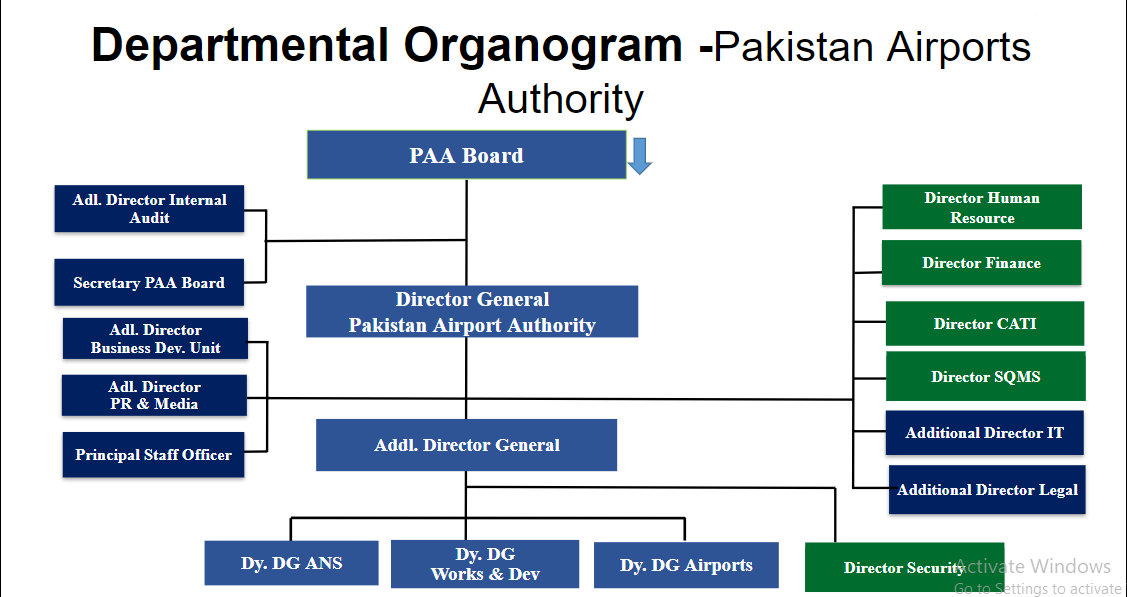
Since the year 2016, efforts have been in hand to further improve upon the functioning of the authority which ultimately resulted in the bifurcation of Pakistan Civil Aviation Authority into three entities. Pakistan Civil Aviation Authority (PCAA) would be the aviation regulator of the country whereas Pakistan Airports Authority (PAA) would function as the service provider function for Air Navigation Service (ANS) and Airport Services (APS). The Bureau of Air Safety Investigation (BASI) has also been formed as an independent body responsible for air accidents & incident investigations. Primary legislation in respect of three entities was promulgated in 2023. At present, the necessary implementation of the segregation process is being carried out.